
If you’re a contractor, you already know the drill: you finish a 10-hour day on the job site, eat dinner, and then sit down to “do the books.” Or you don’t, and the receipts pile up in the truck.
At some point the question shows up: what would it cost to just hand this off? Here’s the straight answer.
The short answer
Most small contractors pay between $300 and $900 a month for outsourced monthly bookkeeping. Businesses with payroll, lots of bills, and higher transaction volume land closer to $900 to $1,500 a month. Many bookkeepers also charge a one-time setup fee, plus catch-up work if your books are behind.
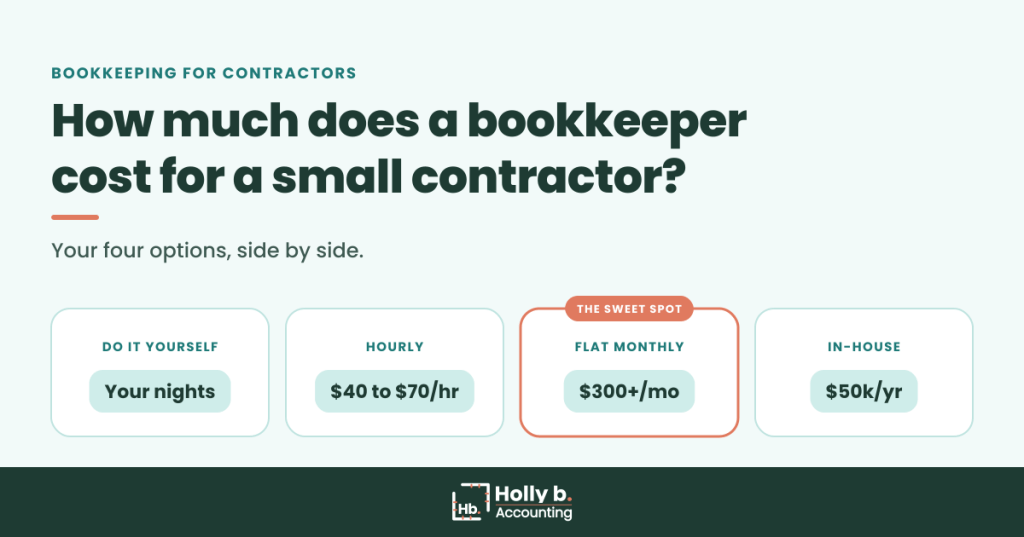
Your four options, side by side
Option 1
Do it yourself
Software only, plus your nights and weekends
The catch: Your time is worth more on a job site or selling new jobs, and mistakes surface at tax time.
Option 2
Hourly freelancer
About $40 to $70 an hour
The catch: Bills can swing month to month, and you’re the one tracking the hours.
★ Option 3: the sweet spot
Flat monthly service
About $300 to $1,500 a month
The catch: Make sure you know exactly what’s included.
Option 4
In-house employee
About $50k a year median pay, before taxes and benefits
The catch: Overkill for most businesses under about $5M in revenue.
For most contractors doing under a few million a year, a flat monthly service is the sweet spot. You get a predictable bill, someone who knows your specific business and closes your books every month without you chasing them.
What drives the price for contractors
Construction books are messier than most, which is why a generic quote often turns into a surprise invoice. These are the things that move the number:
- Transaction volume. Every card swipe at the supply house counts. Ten small runs a week adds up fast.
- Number of accounts. Each bank account, credit card, and line of credit gets reconciled every month.
- Job costing. Tracking profit by job means coding every cost to the right project. It’s worth it, but it’s extra work.
- Payroll and subcontractors. Payroll entries, W-9s, and 1099 tracking for your subs all take time.
- Cash vs. accrual. Accrual books, with retainage, work in progress, and unpaid bills tracked properly, cost more than simple cash-basis books.
- Sales and use tax. Working in more than one state, or buying materials tax-free, adds filings.
- How far behind you are. More on that next…
What catch-up bookkeeping costs
If your books are months behind, you’re not alone, and there’s no shame in it. Catch-up is usually quoted as a one-time project:
- 1 to 3 months behind: about $500 to $1,200
- 4 to 12 months behind: about $1,200 to $3,500
- A full-year rebuild: $3,000 and up
The fastest way to know your number is to have someone look at your actual file. That’s exactly what a books health check is for.
What it costs to skip it
This is the part nobody puts on an invoice. Messy books cost contractors money in quieter ways:
- A bigger CPA bill when they have to clean things up before they can file.
- Missed deductions for expenses that never got recorded.
- Underpriced jobs, because you can’t see which kinds of work actually make money.
- IRS penalties for 1099s filed late or not at all.
- Trouble getting bonded or financed, since lenders and bonding companies want clean financials.
What I charge
No mystery pricing here. Monthly bookkeeping at Holly b. Accounting is $500 a month plus a $750 setup. That covers up to 100 transactions and 3 reconciled accounts each month, a monthly P&L, balance sheet, cashflow report and dashboard by the 15th, payroll entries from your provider, 1099 tracking and W-9s for your subs, and a year-end package for your CPA.
Need job costing, accrual books, bill pay, or sales and use tax filings? Those are add-ons, priced in your quote, so you only pay for what you use. See everything that’s included.
Five questions to ask any bookkeeper
- Have you worked with contractors, builders or trades before, and do you understand job costing and retainage?
- What exactly does the monthly fee include, and what costs extra?
- When will my books be closed each month?
- Do you work with my software, like QuickBooks Online, JobTread, or Ramp?
- How will you work with my CPA at tax time?
Not sure where your books stand?
Start with a free books health check. You’ll get a score, your top risk areas, and a clear idea of what it would take to get clean, with no pressure to sign anything.
Sources: Monthly, hourly, and catch-up ranges are industry estimates from ECOSIRE’s 2026 pricing guide. Median pay for bookkeepers ($50,670 as of May 2025) is from the U.S. Bureau of Labor Statistics. Your actual quote depends on your business.


Leave a Reply