Be honest. When your monthly reports show up, you open the P&L, check the bottom line, and close the email. The balance sheet? It’s that second attachment you’ve been meaning to figure out. For about three years.
You’re in good company! But here’s the thing: the P&L tells you if you made money. The balance sheet tells you where that money went. If you’ve ever had a great month on paper and an empty bank account in real life, the answer is almost always sitting on your balance sheet.
So let’s fix it. Five minutes, one report, no accounting degree required.
The short answer
A balance sheet is a snapshot of your business on one day. It has three parts:
- Assets: what the business has (cash, money customers owe you, trucks, equipment)
- Liabilities: what the business owes (bills, credit cards, loans, customer deposits)
- Equity: what’s left over for you
Assets always equal liabilities plus equity. That’s why it’s called a balance sheet!
Here’s a sample balance sheet for a made-up remodeling company. We’ll walk through it top to bottom. (Click it to see it full size.)

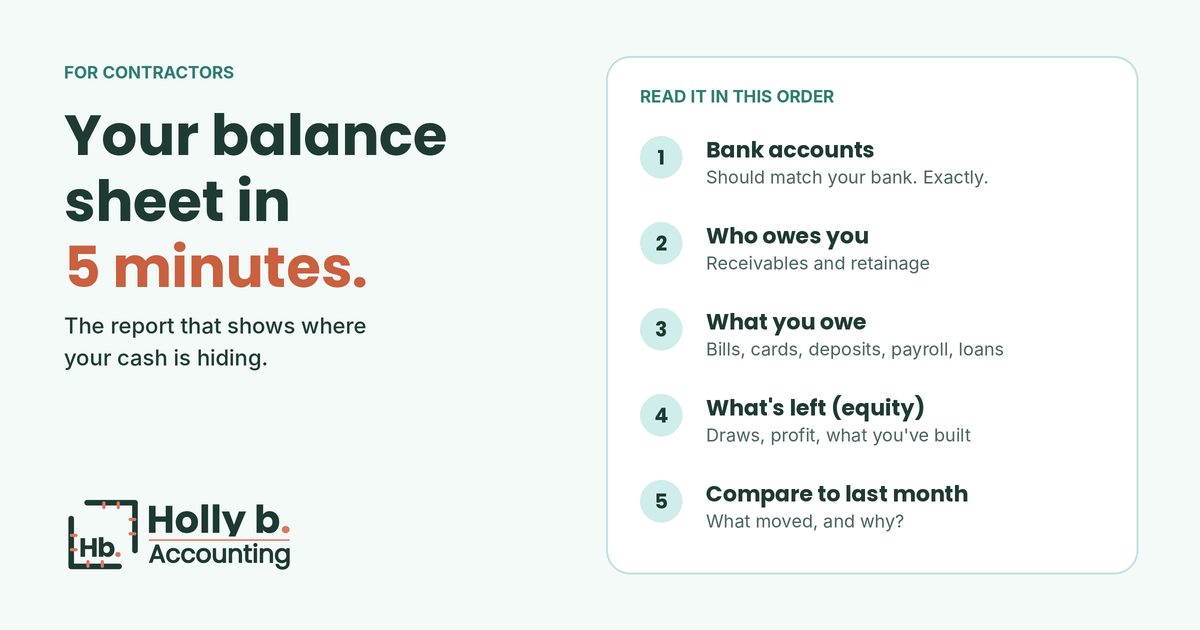
Minute 1: Your bank accounts
Start at the top. Your bank accounts should match what your bank says on the last day of the month. Not close. Exactly.
If they don’t match, the books haven’t been reconciled, and honestly, everything else on the report is a little bit of a guess. This is the first thing I check every single month, and it’s the foundation everything else stands on.
In the sample, you’ll also see a separate tax savings account. Love to see it! (Here’s how much to set aside for taxes.)
Minute 2: Who owes you money
Next up: accounts receivable (A/R), the invoices customers haven’t paid yet, and retainage receivable, the money a GC or owner is holding until the job closes out.
In the sample, customers owe about $72,000, plus another $23,000 in retainage. That’s $95,000 of the company’s money sitting in other people’s bank accounts! When the owner of this company says “we’re busy but I’m always short on cash,” this line is why.
What to check: is this number growing month after month? If A/R keeps climbing while sales stay flat, customers are paying slower, and it’s time to pull your A/R aging report and start making calls.
Minute 3: What you owe
Now the liabilities. This is the money already spoken for, even if it’s sitting in your bank account right now:
- Accounts payable: bills from subs and suppliers you haven’t paid yet.
- Credit cards: should match your statements, just like the bank.
- Customer deposits: this one’s huge for remodelers. A deposit for a job you haven’t started isn’t income yet. It’s money you owe back in work (or in cash, if the job falls through). In the sample, it’s $48,100!
- Payroll liabilities: payroll taxes you’ve withheld but haven’t sent in yet. That’s not your money. Ever.
- Loans: what’s left on the truck, the equipment, the line of credit.
Here’s a fun little gut check: compare your cash to your customer deposits plus your payroll liabilities. If cash is smaller, you’re already spending money that belongs to jobs you haven’t done yet. That’s a stressful way to live, and the balance sheet is the only report that shows it.
Minute 4: What’s left for you (equity)
Equity is what the business is worth on paper after everything owed is paid. It usually includes:
- Owner investment: money you put into the business.
- Owner draws: money you took out for yourself. It shows up here, not on the P&L, which surprises a lot of people.
- Retained earnings and net income: profit from past years and this year that stayed in the business.
What to check: if equity is negative, or getting smaller every month, you’re taking out more than the business is making. Not a crisis on its own, but definitely a conversation worth having before it becomes one.
Minute 5: Compare it to last month
Here’s my favorite trick. Run the balance sheet with last month in a second column (in QuickBooks Online, that’s the “previous period” comparison). Then just look at what moved.
Cash went up $6,000 but you made $23,000 in profit? Great question! The answer is right there in the other lines: maybe A/R went up, maybe you bought a piece of equipment, maybe you paid down the truck loan or took a draw. The balance sheet tells the whole story of where the money went. (More on that in profitable but broke.)
Red flags I look for every month
- A bank or credit card balance that doesn’t match the statement. The books aren’t reconciled.
- A negative bank balance when your real account isn’t overdrawn. Something’s recorded twice, or in the wrong place.
- “Undeposited Funds” with an old balance. Payments got recorded but never matched to a deposit, so your A/R and cash are both off.
- “Ask My Accountant” or “Uncategorized” with a balance. Those are the junk drawers of QuickBooks!
- A/R that never goes down, or old invoices that were actually paid long ago.
- Loan balances that never change, which usually means the whole payment is being booked as an expense instead of split between principal and interest.
If you spotted a few of these on your own balance sheet, don’t panic. They’re super common, and they’re all fixable.
How I make this easier
Every month, I reconcile every bank, card and loan account, clean out the junk drawers, and send my clients a balance sheet they can actually trust, along with a P&L, cash flow statement and a one-page dashboard. All by the 15th. See a sample month-end package.
Not sure your balance sheet is telling the truth?
Start with a free books health check. You’ll get a score, your top risk areas, and a straight answer on what it would take to get your numbers clean. No pressure, and no judgment. Promise!
This post is general information, not tax or financial advice. Holly b. Accounting is a bookkeeping firm, not a CPA firm. The sample balance sheet uses a fictional company and made-up numbers.
Leave a Reply