
⏱ Time: About 20 minutes to set up, then a couple of minutes whenever you slip
Have open: Your Starter Spreadsheet and your bank and card statements
Separating personal and business spending is the habit that makes every other bookkeeping step easier. When only business money runs through your business accounts, your books show what the business really made, every deduction has a clean paper trail, and tax time is a handoff to your CPA instead of a weekend with a highlighter.
IRS Publication 583 puts it plainly: “You should keep your business account separate from your personal checking account.” Here’s how to set that up, and what to do when the grocery run lands on the business card anyway. It uses the free Starter Spreadsheet from The Contractor’s Bookkeeping Toolbox.
Why separating personal and business spending matters
- You see your real profit. Personal charges in the business account make your costs look higher and your profit look lower than it really is.
- Deductions you can back up. A clean business statement is your proof. A mixed one turns every line into a question.
- Faster books. No more wondering if a charge was for the shop or the house.
- Your LLC actually protects you. If you’re an LLC or corporation, mixing money can weaken the wall between you and the business. Ask your attorney or CPA how that applies to you.
Set it up once
- Open a business checking account. Every customer payment goes in here, and only business money goes out.
- Get a business credit or debit card. Business purchases only.
- Move personal autopays off the business accounts. Family phone plan, streaming, the gym.
- Pay yourself on purpose. Transfer money from business checking to your personal account on a schedule, like every other Friday. That’s an owner draw.
- Add the business accounts to your Setup tab. The spreadsheet setup guide walks through it.
When you slip (and you will)
Nobody’s perfect. The fix is to record it honestly, not to delete it or pretend it was a business expense.
Without QuickBooks
Personal purchase on a business account
- Enter it on the Transactions tab like any other line, from the account it came out of.
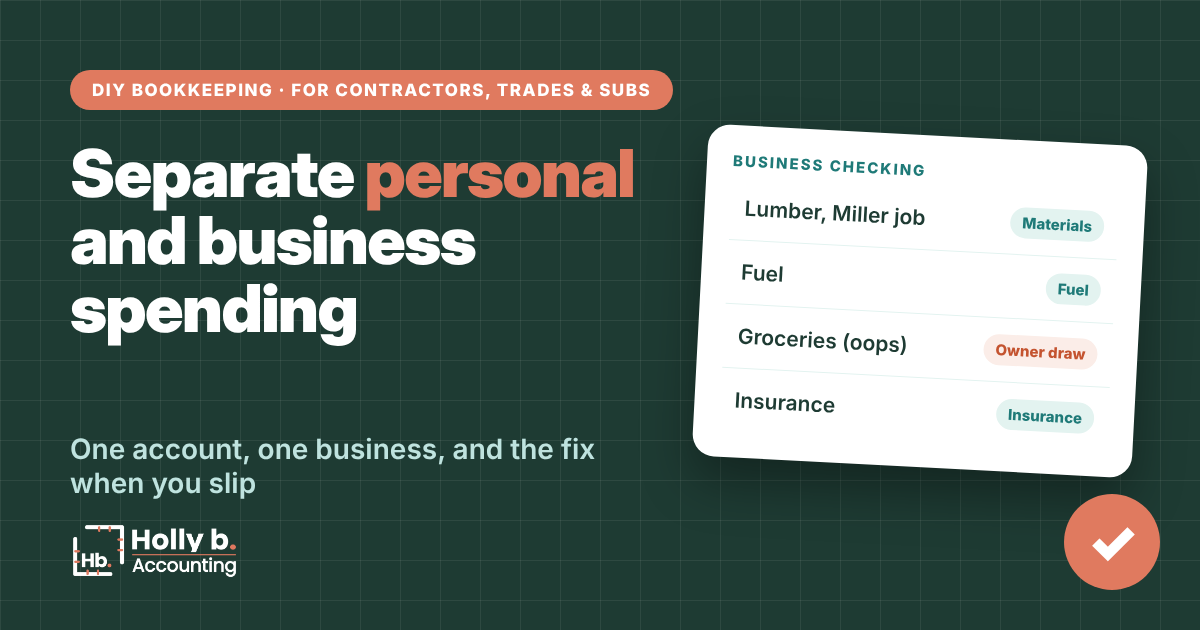
- Category: Owner draw. It’s not an expense, so it stays off your Profit & Loss.
- What it was for: say what happened, like “groceries, wrong card.”
- Job: leave it blank.
- Paid the business back? Enter that as Money in, category Owner contribution.
Business purchase on a personal card
- Pay yourself back from business checking, for the exact amount.
- Enter that as Money out from Business checking, using the real category (like Materials) and the job if there is one.
- In “What it was for,” note it: “paid back, bought on personal card.”
- Save the receipt and mark Receipt saved as Yes. It’s your only proof this was business.

In QuickBooks Online
The same fixes in QuickBooks
- Personal charge on a business account: in the For review list, categorize it to your owner’s draw equity account, not an expense. (Some files call it Owner’s Pay & Personal Expenses.)
- Paid the business back: record a bank deposit to your owner’s equity account.
- Business charge on a personal card: record it with a journal entry, the expense on one line and owner’s equity on the other. Then pay yourself back from business checking to owner’s equity.
- Intuit’s own steps: recording a personal expense from a business account and paying for a business expense with personal funds.

Spreadsheet vs. QuickBooks
Spreadsheet: a personal charge only shows up if you type it in, so it’s easy to skip the embarrassing ones. Don’t. Your Statement Check won’t balance without them.
QuickBooks: every personal charge on a business account pulls in automatically, ready or not. That’s a good thing, as long as you send it to owner’s draw instead of tucking it into Office supplies.
Common mistakes
- Calling it a business expense “just this once.” Personal spending isn’t deductible, and it’s an easy thing for an auditor to spot.
- Deleting personal charges from your books. They’re still on the bank statement, so your bank won’t balance.
- Paying yourself by swiping the business card. Transfer an owner draw instead.
- Thinking the LLC fixes it. An LLC only helps if the money stays separate.
Quick questions
Do I need a separate business bank account as a sole proprietor?
The IRS recommends it, and it’s the single easiest way to keep clean books.
Can my business account be at the same bank as my personal one?
Yes. They just need to be separate accounts, and ideally a business account, not a second personal one.
Is an owner draw a business expense?
No. It’s you taking your own profit out, so it doesn’t lower your profit or your taxes. Paying yourself works differently for an S corp; the paying yourself guide covers it.
I’ve been mixing for months. Now what?
Open the business account today so the mess stops growing. Then go back through this year’s statements and tag each personal line as Owner draw.
Holly b. is a construction bookkeeper who’s spent many years in contractors’ books. She writes these so you can do your own, or so you’ll know who to call if you’d rather not.
Leave a Reply